 |
| Continental Pilots Join Wall Street Occupation on Behalf Their Union ALPA |
The NYPD Keeping the Streets Safe for Casino Capitalism (Updated)
Baseball, Leisure, and Chocolate Chip Cookies

John Buell is a columnist for The Progressive Populist and a faculty adjunct at Cochise College. His most recent book, Politics, Religion, and Culture in an Anxious Age, will be published by Palgrave/Macmillan in August.
Periodically I fall asleep while watching a late night baseball game from the west coast. I have invested in a Major League Baseball package that allows me to choose almost any game every night, but by far the preferred choice is Dodger games. I am a fan of announcers as much as teams. And the former are more stable than the latter, which have become interchangeable parts on a money- driven merry-go-round. My choice of Dodger games owes nothing to Brooklyn or Los Angeles loyalty but rather to appreciation of and fascination with the voice of the Dodgers, Vin Scully.
I have been especially attentive to Dodger games this season. Prior to the start of the season, Scully had announced that this would be his last as Dodger broadcaster. The other night, however, Scully surprised us, albeit with a characteristically soft-spoken announcement.

An admirer had a long tradition of sending him chocolate chip cookies, and this year her gift was accompanied by a note that the cookies were a bribe to entice him to return for another season. As I drifted off to sleep, I expected him to thank her and then explain why the time had come to hang up the microphone. His response, that he would return for his 63d season, both jolted me out of my sleep and led to some reflections on age and retirement. Even if he really loves those cookies, Scully is returning to the booth because he is healthy and loves his job. Many older Americans toil on also out of love for the office, even when they could easily afford to choose the golf course. Sadly, however, an increasing number, even in declining health, are forced to keep working due to America's inadequate social protections not out of love for their work; this is where we all as a society strike out.


Like Harwell's, Scully's commentary is peppered with stories about the players' lives and families. Recently during a scorching Sunday afternoon from Dodger Stadium, Scully regaled us with tales of how players used wet mattresses and cabbage under their hats to cool off in pre-airconditioning times. As with all modern commentators, he has a plethora of statistics upon which to draw, but he does not overwhelm the fan with numbers. I especially appreciate several features that seem unique to his broadcasts. When a runner lands on third, Scully will invariably inform us of the number of wild pitches the pitcher has committed over the season. And when pitchers bat he tell us what percentage of the time they have struck out, a figure that gives a better sense than mere batting average as to whether or not they are klutzes at the plate. My favorite Scully touch is a sixth inning feature, 'This Day in Dodger Baseball,' wherein he tells a story of an event or personality in the long history of the Dodgers, stories often drawn on his own conversations with the players.boasted sports' greatest, most literate and entertaining broadcaster, Vin Scully. (I've long believed that kids who grew up listening to Scully got at least a 30-point bump on their verbal SAT.) Always the most spatially and governmentally scattered of cities --- there are 88 municipalities in Los Angeles County --- L.A. lacked most forms of common civic identity until half the town began listening to Scully.
Longevity in the US has increased and seniors are working longer, both out of choice and necessity. Nonetheless, I bristle at the increasingly popular idea that because longevity has increased and many seniors are doing excellent work well into their eighties, it is no big deal if the Social Security retirement age were to be increased from 65 to 67.

I look around my own working class community with its fishermen, boat builders, carpenters. Despite talk of post-industrial society, much work remains physical and is literally back-breaking. (Such service professions as nursing carry enormous physical and emotional burdens.) And increases in longevity, as Dean Baker has pointed out, are heavily class- skewed. Upper class citizens have more control over their work environments, generally do less physically stressful work, and have better and more regular access to quality medical care. Increasing the retirement age is another attack on the wallets and the health of poor and working class citizens, often depriving them of the few years of retirement to which they can look forward.

Baker also points out that any social security shortfalls, which are exaggerated to begin with, could be alleviated by removing the cap on earned income subject to social security taxation. Much as I like Vin Scully, I believe he and other well compensated professionals working long years at jobs they love should see all of their income taxed, just as is the case for my neighbors, most of whom have few choices about their work.

In a broader sense, the issue of retirement raises profound questions about modern capitalism.At least as far back as the twenties, capitalism's most outspoken defenders promised a future of both material gains and more free time for all. And indeed, despite US capitalism's frequent failures to tap its full human and technological potential, worker productivity has greatly increased. Yet for a quarter century Americans have seen stagnant incomes, longer workloads and no opportunity to trade any wage gains for increases in leisure or earlier retirements.
 |
| Source: The New York Times, Sept 4, 2011 |
The work of human hands

Trent University
There is little doubt that the circulation of appearances is an anxious fact about our contemporary condition. This is made even more acute by the proliferation of events and objects in and through which we interface with appearances, events and things like photography, film, cooking, video games, music, shuffling, paint, apps, reading, advertising, opinion polls, tweeting, posting, and so forth. The Canadian media philosopher Marshall McLuhan - who would have celebrated his one hundredth birthday this year - was influential in disseminating the idea that each medium is unique in the ways in which it handles appearances in the world, whether text, or image, sound, or touch; and through such handlings, extends our own ways of handling the world.

Today, the various media themselves seem to matter less and less because they are becoming ever more fluid: we handle cell phones as easily as we might a camera, or a tablet. However, one thing does seem to stand out as perhaps the most available form of mediatic interface – namely, the screen. Whether cell phones, computers, tablets, televisions, cameras, or what have you, we are living in an unprecedented age of screen exposure, as Kevin Kelly once remarked in the pages of the New York Times Magazine: “Everywhere we look,” he said in 2008, “we see screens.” (“Becoming Screen Literate”, November 23, 2008). This may have made sense 3 years ago, but today we should re-write Kelly’s sentence to say that “everywhere we touch, we touch screens.” Rather than simply sophisticated viewers, we are becoming sophisticated handlers, ‘absorbed by the immediacy of the screen’, as the American popular culture writer, Robert Warshow, affirmed in 1954. [For more on Warshow, I highly recommend the very accessible and extremely well written collection of his essays published under the title The Immediate Experience: Movies, Comics, Theatre and Other Aspects of Popular Culture. Cambridge, MA: Harvard University Press, 2002].
 |
| “BurkaNike” by Pode Bal |
The irony in all this is that despite our well-documented mediatic iconophillia, we have allowed ourselves to accept the idea that anything that appeals to our senses is bad for us, that we are all unconscionable fools because we become absorbed by things that appear before us, that appearances can only tell us lies and condemn us to a life of sin. In this, we persuaded ourselves of a moral theory of the image that says that the only true things in the world are the things we can know, and everything else is ‘mere appearance’, so that all instances of the allure of appearances operate within the same moral and perceptual registers as advertising, or pornography, or both.
If this looks and sounds too polemical - but nonetheless familiar - it is because such reactions have perpetually accompanied cultures of image-proliferation, from the ancient Greeks and Jews, to the early Christians, to the Byzantine iconoclasts, to the Protestant Reformation, to Walter Lippmann, to The Matrix movie, and Wikileaks. All these instances of iconophobia are reactions imbued and embedded with aspects of the First Commandment (the one against idolatry), and they appear and reappear to warn of the damage that appearances can do - to the mind, to the soul, to the eyes, and to the body. Here is what one Biblical prophet has to say about it, in Psalm 135:
15 The idols of the nations are silver and gold,
the work of human hands.
16 They have mouths, but do not speak;
they have eyes, but do not see;
17 they have ears, but do not hear,
nor is there any breath in their mouths.
18 Those who make them become like them,
so do all who trust in them!
The message is clear: “if you don’t stop it, you’ll go blind!”, so to speak. And this lesson rings as true today as it did during its penning. Idols are artifices who appear real but are not - they seem to have all the external qualities and sensory capacities of humans, but none of those things work; appearances are the living dead, vampires, or alien apparitions. And what is worse, the risk of our interface with them is contagion or prodding – if we interface with them, we will become like them. The message of the first commandment, and of these few lines from Psalm 135, is the message of all critique that treats the luminosities of appearances as an instance of deception (this is what it means to be duped by an appearance and thus to be affected by its collusive forces).

I want to suggest another approach to what I call the advenience of the appearance (i.e., its ingression to experience) that takes as a political fact of our contemporary condition that our handling of appearances informs our handling of one another, and that this matters to our senses of politics. It matters to our senses of politics because our handling of appearances multiplies and pluralizes our pictures of political resistance. To treat appearances that advene - on a computer screen, or on the television monitor, or on our cell phones, tablets, etc. - exclusively as claim making entities available to our cognitive understandings takes the fizzle out of those intervals of friction that pose resistances to our ways of interacting with the world.
 |
| London’s Burning: Tottenham. August, 2011 |
A case in point is the recent riots in London and the looting/burning of the Croydon and Tottenham suburbs. Even a tertiary scan of the comments and reactions to this event suggest that they are entirely ensconced within the moral theory of the image I outline above. ‘What we are seeing’ - so we are told – ‘are a bunch of unproductive hoods who have nothing to do other than destroy private property and steal what they otherwise cannot afford to own because they don’t have jobs.’ They are the unthinking, whose time wasted has numbed their minds. They have eyes, but do not see; ears, but do not hear: they have become the consumer products they desire and trust. From the perspective of a moral theory of the image, the scandal of the London riots is exactly the scandal prophesied by the Reverend Thomas Malthus in 1798 in his classic study on the (then) new political economy, “An Essay on Population.” In those pages he outlined exactly how the putting in place of the Poor Laws would - in no uncertain terms - increase sloth amongst the lower classes and create the kinds of attitudes and customs (i.e., lewdness, irresponsible procreation and childrearing, etc.) that we have been told were responsible for the London riots.

Now, several things seem to me worth mentioning in response to the moral theory of the image that governs our general perceptual attitudes: the first is to reiterate a point raised by David Harvey worth making over and over again [see his “Feral Capitalism Hits the Streets”]: looting is a “feral” attitude that neoliberal capitalism created and has been more than happy to defend as a standard modus operandi - just consider, in the US context, whether the sub-prime mortgage disaster isn’t a form of feral looting?

The next point worth mentioning is a point made by the cultural and political philosopher, Jacques Rancière: what I’m calling the moral theory of the image is an instance of a certain mode of thinking that does not want you to stop, look, and see. “There is nothing to see here!” (Ten Theses on Politics, Theory & Event 5.3) is the message we learn from the knee-jerk condemnation of the rioters; that is, there is nothing worth paying attention to because we already know what is wrong with this picture. “There is nothing to see here!” also means that there is nothing political about what has happened. This is a lesson that was parlayed over and over again by the media. ‘The looters have no political agenda’; they’re just looting for the sake of looting. But as Laurie Penny notes, “The truth is that very few people know why this is happening. They don't know, because they were not watching these communities. Nobody has been watching Tottenham since the television cameras drifted away after the Broadwater Farm riots of 1985.” [Panic on the streets of London]. There is nothing to see here, so don’t bother looking.
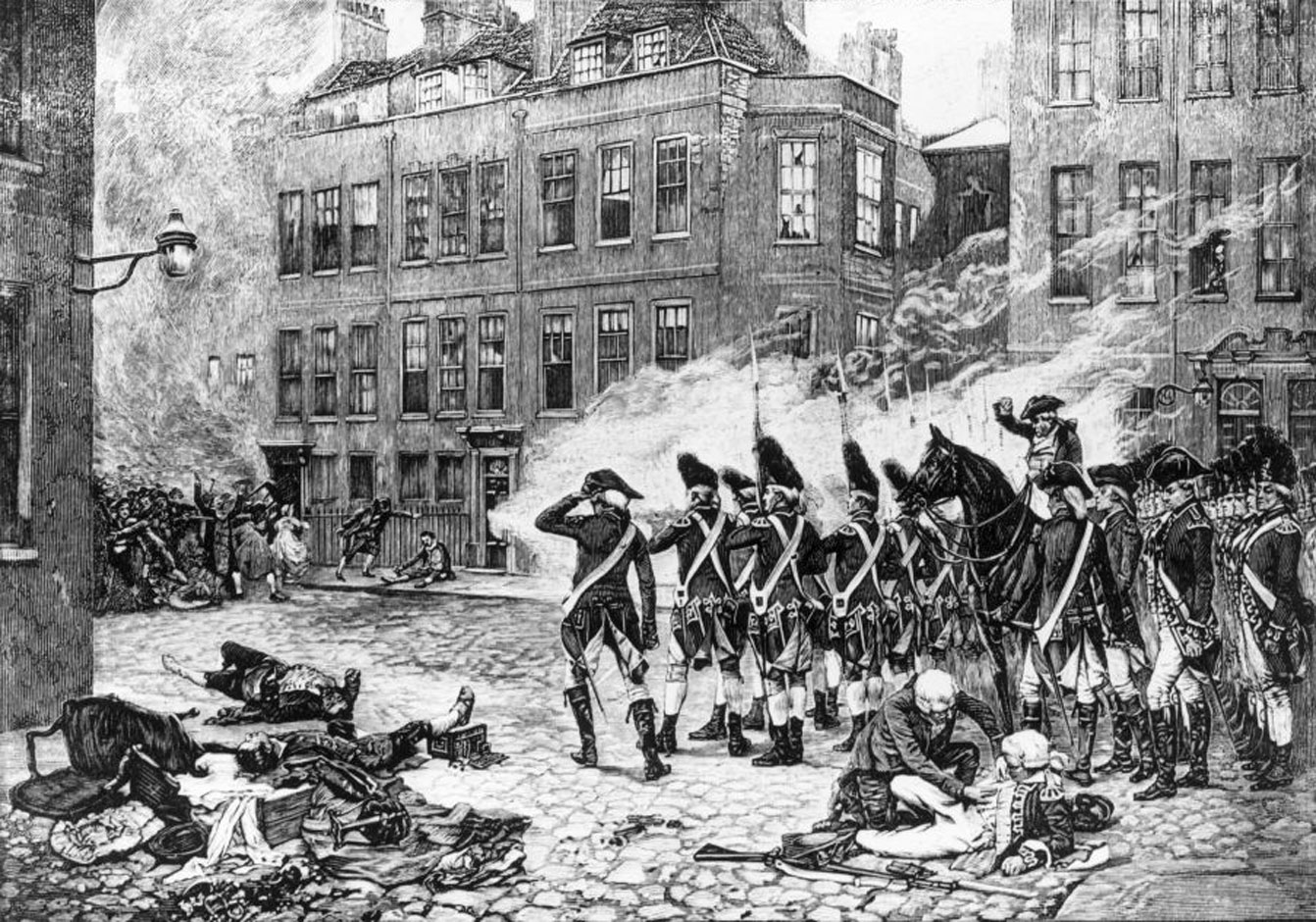
In all of these quick and easy condemnations, little mention has been made of the fact that levelling and looting is a customary practice in British popular politics, at least since the time of the Levellers during the English Civil Wars. Levellers were defenders of liberty in the most literal sense of the term, who would act politically by rioting and destroying property. The attribution of their name comes from a practice they espoused of levelling hedges during riots that divided property lots. The Levellers did not have a set political agenda; they were god-fearing folk who were broadly committed to abolishing government corruption. You can find a selection of their writings here, if you want to learn more. My point, simply, is that levelling and rioting have been, since the discovery of modern liberal toleration and natural rights, a standard political practice autochthonous to British popular rule.
So, in fact, there is something political to see here: namely, that leveling or looting is a mode of resistance that – however unattractive it might be – stands as a form of political action. That Prime Minister David Cameron has elected to call for the eviction of looters and rioters from their homes as a form of punishment for their actions might also suggest that not only does looting and rioting stand as a mode of political action, but that it has juridical consequences (see here; and for a response to Cameron’s appeal, see the ‘Not in my name’ petition here).

This brings me to my final point: to disregard the [recent] London riots as unpolitical and not worthy of our attention is to miss an opportunity not only to address a serious socio-economic problem, but also a potential occasion to re-imagine our pictures of political resistance. This is not to say that we should all turn to Levelling; it is to say that the advenience of an appearance - like the images of looting, or levelling, or rioting - marks an interval in our habits of sensing; to regard an advenience is thus to allow the possibility of an effrontery, or a friction, that bothers us to the core. We are right to be bothered by the London Riots, and it is worth our political while to attend to this irritation.
I will conclude with this provocation: Recent events like the London Riots suggest that the political dilemma posed by neoliberal capitalism is not the adjudication of the priority of the right over the good, or the determination of the good as a right; the political challenge is, rather, the interruption of circulation. And to disregard the multiple portfolios of resistance available through our experiences of advenience, because such experiences persist and subside in a pre-cognitive and pre-judgmental dimension of existence, is to miss significant political opportunities for interrupting the dominion of flow in neoliberal capital. The attitudes of disregard I describe above are moral images of thought complicit and consonant with the increased capitalisation of everyday life.


