Showing posts with label Complexity and Emerging Science. Show all posts

Nationalism, Tech Giants, and Spy States


John Buell is a columnist for The Progressive Populist and a faculty adjunct at Cochise College. His most recent book is Politics, Religion, and Culture in an Anxious Age.


Despite persistent efforts by the US media to cast Edward Snowden as a traitor the affair has managed to expose not only abusive surveillance practices but also (even) the supportive role of strange bedfellows in these practices.


Consider first the tech giants. Silicon Valley's leaders project an image of support for market freedoms and open communication. And they trumpet the growth of high tech as the key to the restoration of our democracy. This image is, however, historically inaccurate and hides the role of the major tech giants today.


The telecom industry grew out of government funding and support for computers and the Internet. These companies in turn have enabled government intelligence agencies to solve some of their thorniest intelligence problems. We have here, then, an incestuous relationship with ugly consequences for a democratic citizenry.


In a recent post in her "Naked Capitalism" blog Yves Smith points out that such government surveillance plans as the infamous PRISM "depict the major telecom and technology players like Google, Microsoft, Yahoo as 'partners'. That's no misnomer... If you think ordinary customers are all that important to them, given that most of the markets they compete in are oligopolies, I have a bridge I'd like to sell you... The NSA, and the Department of Defense in general, have long been sponsors and funders of advanced technology. Need we say DarpaNet?... The NSA is an important customer and validator of tech products."

I Am Obama of Borg, Freedom is Irrelevant, Self-Determination is Irrelevant, Your Technological and Biological Distinctiveness Will Adapt to Service Us


Companies like Google tout cooperation with government. Smith cites Google CEO Eric Schmidt's recent claim in The New Digital Age: "What Lockheed Martin was to the 20th century, technology and cybersecurity companies will be to the 21st."


Smith adds: "If the technology companies were really concerned [about customer privacy], lobbying dollars would go a hell of a lot further than money spent in quixotic fights in the FISA star chamber. But where has Silicon Valley been spending its money?" From a June 2013 story in the Atlantic: So far the fruits of Google's lobbying efforts have resulted in a huge win in an anti-trust case, but the company has even bigger plans...Google is working on updates to the Electronic Communication Privacy Act ­ that pesky bill the government uses to justify spying on your Gmail without a warrant."


Smith also highlights the (most omit) ominous aspects of these revelations:" The extensive cooperation between commercial companies and intelligence agencies is legal and reaches deeply into many aspects of everyday life,... Company executives are motivated by a desire to help the national defense as well as to help their own companies."

I draw several conclusions from these disturbing revelations. US politics has long been characterized by a mindset that political theorist  Bonnie Honig, drawing on the work of the late Michael Rogin, labels countersubversive: "That mentality casts the United States not as a political actor enmeshed in political conflicts with a concrete history, but rather as a hapless victim of alien monsters who appear inexplicably out of nowhere, who might be hiding anywhere, and whose threatening actions justify extreme, often mimetic, (re-)actions on our part."


She quotes Rogin: "Both the postwar Soviet Union and the radical labor movement of [the 1910s] posed genuine threats to dominant interests in American society, although the nature and extent of those threats are a matter of controversy. .. But the countersubversive response transformed interest conflicts into psychologically based anxieties over national security and American identity. Exaggerated responses to the domestic Communist [we could now say Arab] menace narrowed the bounds of permissible political disagreement and generated a national-security state." Indeed, we should say that linking labor to national security issues plays a major role in the defeat of welfare Keynesianism and the later hegemony of neoliberalism.

Perhaps the strangest revelation so far from the Snowden affair is the role of our erstwhile enemy in dismissing or denigrating his principled exposure of government lies and abuses. In his first response to Snowden's request for political asylum, Russian president Vladimir Putin demanded: "He must stop doing work aimed at harming our American partners, however strange that may sound coming from my lips." Putin, like the US corporate media, seemed to feel no need to explain just how Snowden's disclosures had harmed his "partner." Though Putin has now granted Snowden temporary asylum, his long term situation remains quite tenuous. Apparently, however much these national security states may see their opposite numbers as threats, each uses these threats to defend their own abusive bureaucracies, practices and secrecy from their own citizens.


Today, spy agencies all over the world, both whether governmental or private, accumulate reams of personal data with which they can denigrate or disrupt any dissenting politics, regardless of how nonviolent. And here in the US with the especially close ties between private corporations and the national security state, an already strong tendency among elites to identify all anti-corporate dissent as inherently violent and destructive will only intensify.


Even citizens who proclaim they "have nothing to hide" will  lose the stimulation and challenge of a venturesome culture and politics. Eventually, denied any outlet and opportunity to express and refine with others, those creative thoughts themselves may no longer come.

Finally, so much for both classic laissez faire and countercultural hopes for American democracy. The former, most notably Milton Friedman, argued that free markets and capitalist development nurtured freedom of speech and thought. Not only do markets often require the coercive power of the state in order to form, once formed they hardly ever remain free. Corporate power grows in tandem with and through government. And the state is then called upon to join other institutions in  helping to shape workers, consumers, church goers, the poor and so on to fit "the roles" the system has defined for them. this is an imperative of neoliberalism, not one of its side effects.


That's is one reason it is hard today to remain aloof from politics. But for those who seek to do so the message is just as clear. If the Internet has progressive possibilities, their realization will not be automatic. Today a countersubversive culture nurtures and is nurtured by an evolving alliance of high tech giants, government bureaucrats (whom Smith calls securecrats), the older more established military industrial complex and powerful private corporations that benefit from close ties to the state, including especially the oil  and investment banking community.


If the most repressive outcomes are to be avoided, the best course might be an evolving counter-coalition that would emerge from moral and historical critiques of and alternative to the countersubversive tradition. In Emergency Politics, Honig argues that the very focus on the question of the rules that should govern declarations of emergency and the protections that can be revoked in emergencies reinforce a notion of sovereignty as unitary and top down. Thus they "marginalize forms of popular sovereignty in which action in concert rather than institutional governance is the mark of democratic power and legitimacy." Unitary and decisive sovereignty committed to its own invulnerability is "most likely to perceive crisis where there may only be political conflict and to respond...with antipolitical measures."


The best answer lies not merely in challenging the constitutional status of this surveillance state but in building a political coalition that embodies the forms of popular sovereignty of which Honig speaks. This would include labor, consumer and environmentalist critiques of and alternatives to the role of the state and markets in fostering inequality. It would be attentive to the possibilities and risks of the social media and the limits of its own interventions in these.  The coalition might advance more democratic forms of enterprise and media as well as decentralized and more sustainable forms of energy production and transportation.  And in an era where hyper nationalism erodes so many democratic impulses, cross border initiatives in the interest of widespread access to an open Internet with robust privacy protections would be paramount. (Let's hope that) Edward Snowden's travels (in a world dominated by the state passport and surveillance system) helps to highlight the stake citizens of many lands have in a democratic Internet but a more exploratory and democratic polity.

“The East” and Corporate Terrorism

William E. Connolly
Author of The Fragility of Things: self-organizing processes, neoliberal fantasies, democratic activism, Duke, fall, 2013

As I compose this I am sitting on a gorge in Ithaca, New York, a gorge formed over endless centuries by the loud, cascading falls situated at one end of it. I sit here the day after seeing “The East,” a May, 2013 film on corporate eco-terrorism, private intelligence firms that secure them, and the closeted eco-warriors who stalk both by adopting parallel tactics. The title is meant to recall the underside of the privileges bestowed upon the corporate east in America and the mess in the middle east today. But the geological resonance is also pertinent because some geologists contend that the Biblical story of Eden, situated in “the middle east” 6000 years ago, is actually a mythic condensation of faint memories passed down to later generations of a bygone era when an area stretching from the Arabian peninsula to the current Sahara had been a vibrant, fertile, green zone. Over a short period a radical change in climate transformed it into a desert. There are even remains of a sophisticated structure reminiscent of Stonehenge through which the leading intellects of the day tried to figure out what in hell was happening to their climate and world. 
The condensation of that climate event in Genesis, at least as interpreted by Augustine, is one in which the first humans in the garden rebelled against God and we were all punished severely for their rebellion: labor in child birth thereafter for women, toiling in barren fields for men, and the experience of death for all. Climate change, human willfulness and divine punishment. The story is often used as a lesson in obedience, but also lurking in it, especially in the earliest J version, is a sense of powerful natural forces  which we must tend as best we can. The Book of Job puts both stories into play too. Here is a somewhat different story: The first humans did not deserve what they got; we may deserve what we are sowing; future generations may reap the effects of our original sin.
“The East” is directed by Zal Batmangli and stars Brit Marling (who also co-wrote it). It co-stars Ellen Page and Shiloh Fernandez. Sarah works for a spooky corporate intelligence and undercover agency that infiltrates and breaks up eco-warrior groups. Our heroine is assigned to infiltrate an undercover group devoted to locating corporate eco-terrorism and enacting “jams” to make them experience precisely what their policies do to others. Does you pharmaceutical company produce a medication that creates severe mental dissociation? Do you then deny it?  Let’s infiltrate the company celebration and pour the same medication into their drinks. Does your manufacturing company pour toxic wastes into the river at a precise time every night? Let’s capture the bosses and compel them to swim in the river just as the toxic brew gushes out of the huge pipe above them.
Reviews of the film so far often ask whether the suspense works well and whether the infiltration strategy is realistic. Demote those questions. The key thing is that Sarah soon becomes a double agent, not in the sense of playing both sides against the middle for her own gain. But in the sense of finding that part of her comes to identify with the goals and practices of the eco-warrior group and that part clings to the cool, more cynical analyst loyal to the firm. Also, part of her is mesmerized by the warrior tactics—who would not feel a thrill as you see those corporate cads swim in the slime they have brewed?—and part of her is drawn to bring the cool, technical knowledge and tactics she has learned at the firm to a new cause. She is a doubly identified agent. In this way she captures the predicament many of us are caught in today. We are appalled by corporate eco-terrorism; we find our responses to it to be inadequate; we fear for ourselves and families when we consider other options; and we don’t want to become as dogmatic and punitive from our side as the corporate terrorists are. We think that the latter approach will backfire. And yet we are dissatisfied with our current modes of double agency. 
Eventually Sarah develops a strategy of public expose and activism that draws some sustenance from her two identities and resists the traps each sets for her. I will let that part unfold when you watch the film. Is it enough?  Probably not. Could more of us participate in such acts to augment the potential they hold? Yes, we could. Many of us are what Michel Foucault called “specific intellectuals”, people with special knowledges and skills because of the work we do in law firms, medical practices, college teaching, blog writing, pharmaceutical companies, intelligence agencies, the media, school boards, churches, geological research, corporate regulatory agencies, and so on, endlessly. Each of us has specific modes of strategic information and critical skill linked to our role assignments. We can expose horrendous practices, as Snowden has done recently. We can also support others who do so as we seek to build a critical assemblage of public insurrection together. 
Sarah provides a metaphor and exemplar for our time. Those two innocent children in the fertile garden did not deserve the fate imposed upon them. They therefore suffered a double injury: the fate and their sense of deserving it. And we today? We either contribute to the fate that will befall us or withdraw from fights against corporate eco-terrorism. The next generation will not deserve the fate bestowed upon it, but we are saddled with differential degrees of responsibility. I have explored multimodal kinds of action to be pursued under such circumstances in a recent post on “The Dilemma of Electoral Politics”.  The cool Sarah does much more. She acts in ways that inspire us to think and act differently.
What about the warrior clan she infiltrates? To me, they simultaneously inform us, slide too close the adversaries they oppose, and pursue some actions that are apt to backfire under the glare of publicity. Are they, though, also invaluable prods? Yes. They are, perhaps, the Antigones, Nat Turners and John Browns of today. They force us to rethink, with Sarah, how we remain caught in oh so carefully crafted circles of self-protective pessimism, or cynicism, or innocence, or indifference. They spur us on. They press us to consider again just what mix of courage and tactical wisdom are appropriate to the fateful issues of today. We need the intensity they exhibit joined to multimodal critical practices, ranging from role experimentations through exposes to social movements and electoral politics—each of these enacted as an indispensable contribution to the others. Check out the film. Exacerbate, in the company of others, the double agent circling within you.

The Austerity Trap

John Buell is a columnist for The Progressive Populist and a faculty adjunct at Cochise College. His most recent book is Politics, Religion, and Culture in an Anxious Age.

The Eurozone is in a deep recession. Some members even face conditions not seen since the Great Depression. Spanish unemployment tops 27 percent, with half of its youth unemployed. Not to worry, say the elites of the European Central Bank. Spain, Italy, Ireland, Portugal, and Greece, aptly abbreviated as the PIIGS, are getting what they deserve. They have spent beyond their means. Once they reduce their deficits—preferably by cutting benefits and services—confidence in the markets will increase and investments will flow in. Swallow your medicine, eat your vegetables, and all will be okay. Here in the US, despite persistent unemployment, budget deficits remain an obsession, at least with the elites. This conventional wisdom now has a new name, expansionary austerity. Austerity in its various forms and guises is the subject of a comprehensive and provocative new study, Austerity: The History of a Dangerous Idea by Brown University political economist Mark Blyth.


Blyth cites the many failings in this diagnosis and prognosis. Some of these will not be unfamiliar to regular readers of Paul Krugman's New York Times column and blog, but Blyth more fully acknowledges the importance of uncertainty in economic life, attributes more significance to the role of investment banking, and develops an interdisciplinary approach to the crisis.


With the exception of Greece, none of the PIIGS had levels of debt that disturbed markets in earlier eras. Ireland and Spain were models of fiscal rectitude. The sovereign debt crisis emerged only after their private sector banks had inflated a massive real estate bubble. This process was driven by a major transformation in the private banking world. In the eighties, as banks lost customers to the corporate short-term capital markets, they needed another business model. That model evolved to include consolidating and offloading mortgage securities. These securities bundled many homes at different levels of borrower economic strength. Risk calculations for each level were based on sophisticated mathematical models. These assumed a normal, bell curve shaped, distribution with Texas housing losses during the 1980s S & L meltdown of 40%, the worst in their sample, as the outer bound, lowest probability event. This market was further pumped up by a new form of security, the Credit Default Swap (CDS). These allowed purchasers of these multilayered securities to obtain insurance against their default.


Assuming a normal distribution, bank economists argued that a 40% decline in value of all mortgages in one of these synthetic securities was a once in a third of the life of the universe event. But as Blyth points out, "if you haven't been around for a third of the life of the universe, then how can you know what is possible over that time period? It is the assumed distribution that tells you what is possible, not your experience." (Emphasis mine) In addition, the providers of the CDS securities were unregulated, allowing them to become enormously overextended. This concoction had an unforeseeable dynamism not reducible to the sum of the parts. Its creators could not imagine that "the meshing of elements that were each intended to make the world safe, such as mortgage bonds, CDSs, and banks' risk models, could make the world astonishingly less safe. "


In Europe, this model had even worse consequences. Its banks were more concentrated and leveraged than even US banks. They soon became insolvent, threatening the complete collapse of national economies. In order to avoid such disaster, the governments of Ireland and Spain absorbed the debt, thus staining their own once pristine balance sheets.


If government deficits did not cause the problem, public sector retrenchment will not end the financial crisis. Households, having lost much of their net worth in the collapse of the real estate bubble, are reluctant to spend. If governments also slash expenditures, from where does the spending upon which the economy depends come? Your spending is my income. Advocates of expansionary austerity argue that confidence will be restored when governments shrink, thus assuring businesses that future profits will not be taxed away. But business is likely to respond only to tangible demand in the market place rather than to uncertain promises.


But the evolution of mainstream economics from the fifties on had left policy makers with few tools to address the uncertainty and unpredictability of markets. These economists, Paul Samuelson most prominent among them, had reduced Keynes to the contention that economies can be fine tuned by interest rate adjustments or at worst by discrete, specifiable in advance, injections of fiscal stimulus. Market economies were thought to display steady and predictable tradeoffs between inflation and unemployment and policy makers could choose the most desirable point. When the stagflation of the seventies came along, with high unemployment accompanied by high rates of inflation, Chicago school economists had an entry to argue that Keynes was wrong and that markets should thus be left to do their own thing.


Chicago had, however, slayed a paper tiger. Keynes was far more than an advocate of "fine tuning" via fiscal stimulus. He emphasized the uncertainty and unpredictable dynamism of markets. Capital, commodity, and even labor markets can be governed by self-reinforcing swings both internally and with each other in a climate where the future is uncertain. No single fiscal injection or interest rate adjustment can be sure to work. Thus post Keynesian economists like Nicholas Kaldor advocated international commodity reserves, especially for oil and wheat, to limit the damage of commodity speculation. In labor markets, governments could make full employment guarantees, using as much spending as it takes and even direct government hires to restore full employment. Such policies would not abolish capitalism but would rather mitigate its self-destructive potential.

The world, however, has moved in the opposite direction. The Eurozone has no central government with the power to tax and spend. When a bubble in Spain collapses, the Spanish government cannot devalue its currency. Nor can it spend more to reflate its economy and recapitalize its banks without seeing interest rates soar to unsustainable levels. And once markets see this process unfolding in one nation, speculators look around for the next most vulnerable. Their actions often provoke the next crisis. This is a true doomsday machine, as Blyth argues.

The Future of Austerity

Austerity advocates, who like to deem themselves as orthodox scientists swayed by the data, are unmoved by a totality of evidence that would surely prove persuasive in other contexts. How can a doctrine that has consistently failed in practice survive so many reverses? Perhaps the greatest strength of Blyth's work is his explanation of austerity as a leading example of what John Quiggin calls zombie economics. Despite having been killed repeatedly, it lives among us. There is an intellectual and a moral or even identity component to the survival of this bankrupt idea. Lockean notions of government's limited role as defender of individual property and the right to individual appropriation and accumulation of nature's bounty, made possible by money, is a key and deeply embedded theme in American culture. Adam Smith admits the need for government, if only to protect the rich against the envy and ambitions of the poor. But he worries about how to pay for it and is concerned that debt will lead to default and inflation that will erode the wealth of lenders.


Most telling and enduring in Smith is the morality play that so resonates today: "Saving is a virtue, spending is a vice." According to Blyth, Northern European savers "are juxtaposed with profligate Southern Europeans, despite the fact that it is manifestly impossible to have overborrowing without overlending... The conditions of austerity's appearance, parsimony, frugality, morality, and a pathological fear of the consequences of government debt—lie deep within economic liberalism's fossil record from its very inception."

Austerity will not continue forever. The reason for its demise is not its unfairness, though it is. It simply does not work. Continuing rounds of fiscal cuts depress net wealth faster than debt. Eventually populations revolt, not always in sensible and humane ways, as the experience of the Thirties suggests. Blyth makes a powerful case that austerity was a principal cause of the rise of fascism in Japan and Germany and thus of World War II.

Members of Greece's neo-Fascist party, Golden Dawn 
There are alternatives. Blyth guardedly speculates that the current investment bank business model is on its last legs. There may not be any remaining asset classes for investment bankers to "pump and dump." If that is the case, how sad that we have pursued a long, painful austerity to preserve this parasitical creature. Iceland may have been a better role model. Faced with its own banking crisis, it allowed its banks, with assets equal to ten times the nation's GDP, to fail. It recapitalized its banking system at far less cost than keeping its troubled ones alive. It devalued its currency and imposed capital controls so that speculators could not take their funds out of the country. In addition, it stimulated its economy at least until the worst downturn had been prevented. And once the economy started to right itself, government turned toward taxation of the wealthy. Iceland has far outperformed Ireland, which has followed the orthodox austerity course.


Neither Keynes nor Blyth ever said that debt does not matter. But today's heavy debt load is not a result of an irresponsible democratic government. Nor is a deep recession the time for cuts in an already inadequate welfare state. And once growth resumes, taxes would be appropriate—especially on those who have profited most from the bailout of the banks, tax avoidance, or tax rates lower than those paid by typical working citizens. But taxation alone as a path toward economic justice may be a difficult sell in America, where the prevalent mindset is "I earned it and I should get to keep it." Policy should thus also aim for reforms that foster more justice in labor markets. Over the last forty years workers have seen gains in their productivity unmatched by any increase in their real income. In a full employment economy labor can demand its just rewards. And as Dean Baker has pointed out, intellectual property holders and high income professionals use the law to extract monopoly pricing power even as blue collar workers face the perils of the free market.


Banks also merit special attention. Even if their business model is dying, steps might be taken to hasten this process. Blyth suggests financial repression, forcing them to hold low interest government bonds, thus gradually eroding their assets until total national debt is reduced to tolerable levels. In Debunking Economics, Australian economist Steve Keen presents a related idea. He acknowledges that debt forgiveness can hurt creditors, a class that might include workers' pension funds as well as affluent investors. He advocates instead a simple one-time grant of say $50,000, which can be spent only after it has been used to pay down any personal debt. This proposal has several merits. Because it is universal, it would help the thrifty homeowners sufficiently who have paid off most of their mortgage while also aiding those under water from home or student loans.

Other post Keynesian economists have advocated changes in banking law that would make bank executives doubly liable for losses in investment schemes, a measure that would surely change the whole incentive structure of banking. Banks must be returned to their role as handmaidens of industry rather than as parasitical speculators. With such changes the corrosive inequalities of the last decade can be mitigated.


One final thought I draw from Blyth is that combating the dangers of austerity may require more than economic arguments. It will also need an ethical critique, one that awards consumption its place. Such a message may seem dangerous in an era of environmental limits. Consumption, however, need not be limited to the corporate driven consumerism of our era. We might revisit John Kenneth Galbraith's moral critique of two generations ago, with his contrast of private affluence and public squalor. Especially necessary is public sector spending on a new green infrastructure, on preventive health care, university education. Equally important would be public and private art. The gains from technological progress can also be "spent" on more leisure, with all its possibilities, rather than more goods. Austerity is a passionate opponent and demands a multifaceted response.

After Sandy, The Politics of Public Things

Bonnie Honig
  Northwestern University


In response to the contemporary neoliberal impulse to privatize everything and the difficulty, in such a context, of preserving public things and of articulating the importance of public things to democratic life, it is important to think about public things.
A few weeks ago, Sesame Street’s Big Bird became a symbol of this struggle though it was not named as such. We witnessed, after the first US Presidential debate, some discussions and disagreements regarding how much money could be saved by Mitt Romney’s promise, at the start of the debate, to cut government funding to PBS. 
The amount of money involved is relatively small, and most of the budget of PBS is raised already through private fundraising, so commentators see this as one more meaningless cut, or as red meat for the right which wants cuts regardless of their size. The former dismiss the gesture, the latter appreciate it, but both see it as a gesture. But what (else) is in that gesture? Surely something other than money is at issue here for both critics and defenders of Big Bird.
  If there is so much brouhaha over Big Bird, if the attachment to it seems fetishistic or infantile, this may be symptomatic of the fact that it is one of the few public things left in the US.

What is not said, or certainly not enough, is that it is not about the money. It is about completing the privatization and destruction of the public things of American democracy, a project that has been ongoing for over 30 years. To most American conservatives, government itself is only a necessary evil (except on the point where they split: the legislation of virtue or family values) and, these days, even those of its functions that have been historically conceded by conservatives to belong properly to government, like imprisonment, border policing, and military defense or adventurism, are increasingly sold off or subcontracted to private industry. All that is left to government to do is to make the policies whose discretionary implementation these subsidiaries execute. The claim is sometimes that these private companies can do the job better or more efficiently, or that they are better job-creators than the government. (Either way, note, it is about getting the “job done," a phrasing that should strike readers of Hannah Arendt as particularly problematic in a political context.) 
But the real issue here, surely, is a political orientation rooted in a fundamental antipathy to public things and their sometimes magical properties which, not to put too flat a point on it, Big Bird represents. Everybody loves Big Bird! was the refrain after the first Presidential debate. Exactly. And democracy is rooted in common love for such shared objects, or even in contestation of them (which betrays a common love, more than sentimental claims of devotion do). Is it the object that we love (and contest)? Or is it the seemingly a-political but really deeply political publicness it instantiates? 
This is different from the mass consumerist need to all be in love with the same private object – the newest iPhone, say -- and to have one, of which there are millions. That said, this consumer need may well be the ruin, the remnant, of the democratic desire to constellate affectively around shared objects.
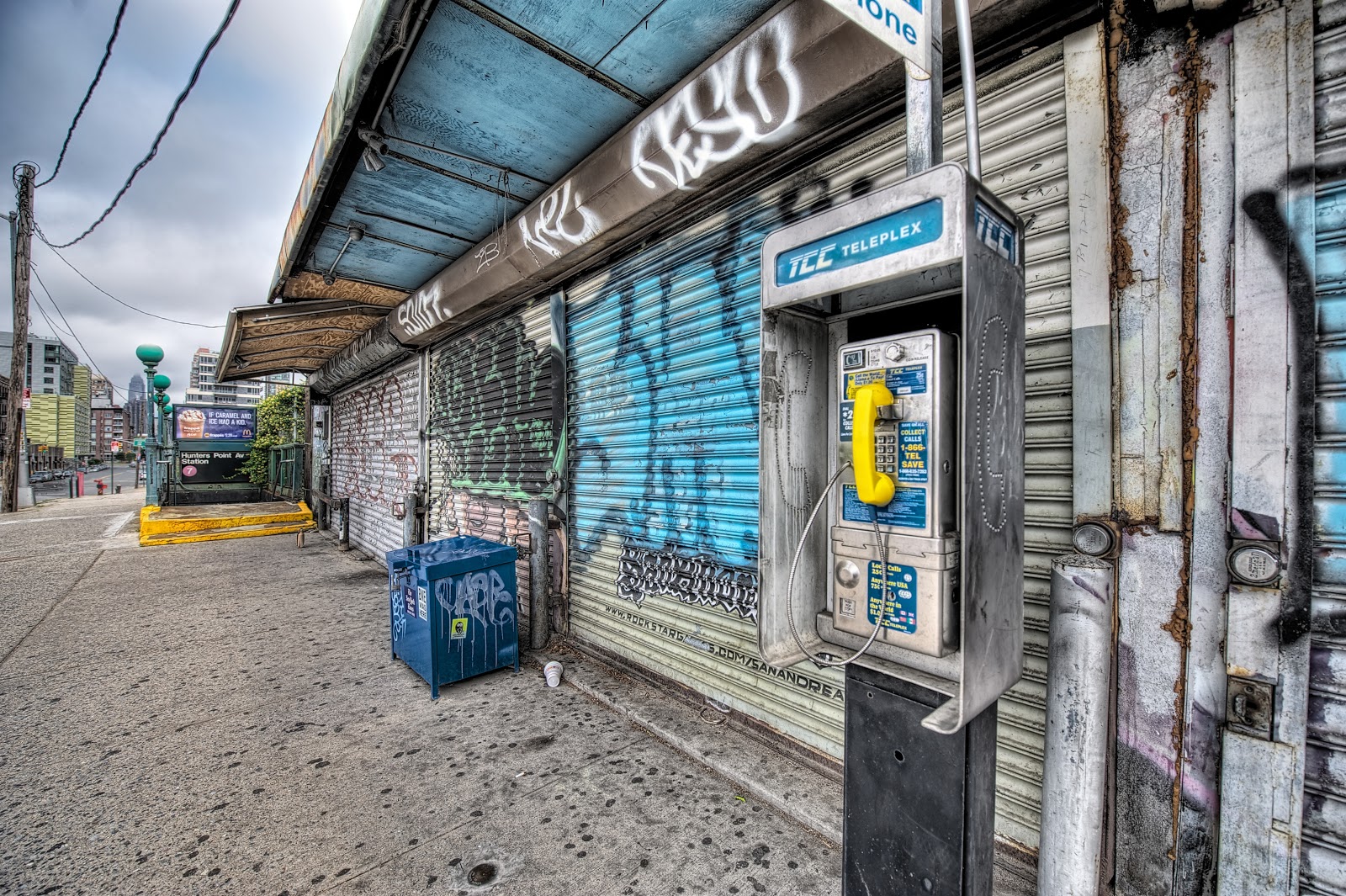
The ruin speaks out sometimes, though. For example, after Hurricane Sandy, pay phones, normally treated as part of the city’s ruined landscape, emerged suddenly to become communications life-savers; relics with an afterlife. As Ben Cohen noted, “Natural disasters tend to vindicate the pay phone” which is “mounted high and sometimes behind glass stalls [and so] generally remain serviceable during power outages, even amid flooding.” Focusing on the only problem would-be users now face, coin-overload, however, this journalist misses the real importance of so-called pay phones. They are, as indeed they were once called, public phones, situated on the streets and available to everyone. 
Though not publicly owned (they are now serviced by 13 different local pay phone franchises) they are regulated by New York’s Dept of Information Technology and Telecommunications. Said one new user of the old technology “it’s funny what’s hiding in plain sight…it’s invisible, but when you need it, it’s there.” Surely, that quaint trait of the public telephone stands synechdochally for the quaintness, in our neo-liberal context, of publicness itself. That is, it is not just the technology of the phones that is like a relic from a past time. What is funny, invisible, but hiding in plain sight is the idea of public goods, goods that conjoin people, and are to be shared among various users from all kinds of backgrounds, classes, and social locations. 
At the moment, in the aftermath of Sandy, there is talk about demanding better cell phone towers to secure coverage in emergencies, but this response is rather like the decision to build more roads for cars a century ago, in place of public transportation. There should really be more talk of securing more pay phones and more appreciation of the fact that the ones they have in NYC, that most palimpsest-like of all cities, in fact seem to work. 
The longing for public things may in fact have found expression in this week's return to discussions of climate change. It could just be one more round of emergency politics. But it could be also, or somehow, a subtle promise of collective goods, demanding our attention, offering a site of constellation to those hungry for public things.

Hydrofracking and Home Rule


Jake Greear
Johns Hopkins University

With world leaders failing to make headway toward curbing carbon emissions at the 2009 Copenhagen Conference, and quietly throwing up their hands at this summer’s Rio +20 Summit, it may be time for environmentalists to focus energies on the dispersed global sites of fossil fuel extraction.  To that extent, the political battles now playing out in the Northeastern U.S. over the natural gas extraction process called hydraulic fracturing, a.k.a. “fracking,” merit attention. 
As energy companies run up against the political and natural limits of petroleum and coal exploitation they are turning to increasingly outlandish means to tap alternative fossil fuel deposits like tar-sands--where extraction means scraping the living surface off vast swaths of Canada--and the natural gas held in the Marcellus Shale under the northern Appalachian Mountains--where extraction means shattering billion-year-old rock formations that undergird the North American continent.  

Paul Thomas Anderson’s film There Will be Blood poignantly dramatized the violence inherent in fossil fuel extraction.  However, the sites of large scale hydrocarbon extraction are often either sparsely populated or inhabited by communities with few means of resisting the insults and injuries that are the usual local byproducts of extractive industries.  Most consumers of fossil fuels live a world away from their strip mines and oil fields.  
The Alberta tar sands are an example.  The construction of pipelines needed to carry tar sands oil to markets has been stalled for now, but the oil companies are not really worried.  They will get the oil out one way or the other.  The fortunate thing, from the industry’s perspective, is that not many people live in northern Alberta, so there is relatively little opposition in defense of the forests and rivers that are being destroyed there.  
The Marcellus Shale formation, by contrast, runs under densely populated parts of West Virginia, Pennsylvania, and New York.  The directional striations of the shale dictate the topological terms of methane extraction.  The industry sees the entire area divided into a staggered checkerboard of 1/2 x 2 mile quadrants oriented north-northwest, with a gas well in each one.  But to achieve this ideal energy companies must contend intensively with innumerable landowners and residents.
For many people living on the Marcellus Shale the revenues from gas extraction offer a way to ride out tough times on family farms that are obsolete by agribusiness standards.  But the opposition movement that has grown throughout the region voices serious concerns about quality of life, environmental health, and safety.  And in the ensuing political discussion bigger-picture issues like energy security, economic sustainability, and global warming have also become part of the conversation.  
In New York state particularly, fracking has come to the forefront of local politics in many municipalities.  Corporations long ago began haggling with willing landowners for drilling leases.  However, they have not yet been cleared at the state level to frack New York, and while they wait for the state’s go-ahead several townships have moved to protect the neighbors who stand to be fracked against their will, adopting ordinances ban fracking locally.  Although these efforts have met legal challenge, local anti-fracking ordinances have so far been upheld. 
The opacity inherent in the fracking process has served to stoke an already heated controversy.  First there is the fracking fluid injected underground in massive quantities.  It is known to be toxic, but the contents are protected as trade secrets.  Then there is the opacity of the earth itself.  Seismic imaging, lab tests, and trial and error tell us something about what is happening in the fracking process, but there is a limit to what we can know about the deep earth. No one has ever been down in a fracking well--they are six inches across and miles deep.  Like many other amazing technological feats, fracking remains an art even though it is served by science.  And because it is an art there cannot be any guarantees of ecological safety.  As with deep water oil drilling, no number of government inspectors will eliminate the extra-ordinary risks to lives, places, and ecosystems that an undertaking of this scale and technological complexity poses.
What we do know is that the earth is a big, complex thing full of surprises.  Paleo-ecology tells us that our particular world is characterized by both resilience and fragility--prone to tipping points, feedback mechanisms, and emergent phenomena that are not predictable.  Fracking is an amazing and ingenious technology that can do big things, like releasing a planetary amount of methane from the earth’s crust.  But the problem with doing big amazing things is that other amazing earth-scale events can be unintentionally triggered.
So far the unintended consequences appear to be relatively localized--methane gueyser eruptions, man-made earthquakes, poisoned waterways, and a few polluted aquifers.  Of course, few of these phenomena can be linked with certainty to fracking--once again, due to the opacity and complexity of the process.  Corporate representatives use this opacity to industry advantage as “merchants of doubt” painting themselves as practical and reasonable--“just show us the proof?!”--while slick TV ads promise “clean burning natural gas” is the “transition fuel” that will usher in a green-energy economy... any decade now!  The lie by omission is that the methane that necessarily escapes during the extraction process is many times more potent than other greenhouse gasses.
The fragile bulwark that some New York townships have erected against this well-lobbied industry draws upon the strong political tradition of “home rule” in the Northeastern states.  Home rule is the decentralizing political principal within a federal system, giving local municipalities the right to institute any statutes not prohibited or superseded by higher levels of government.  
There are voices on both sides who oppose New York’s adventures in ecological home rule.  Some claim this issue is too complex and important to be left up to town councils.  And of course whenever fracking is ruled on locally--either to permit or to ban--there will be a minority who feel strongly that their rights have been trampled upon.  Moreover, some fracking opponents even worry that while each local anti-fracking ordinance seems like a grassroots victory for the cause, deference to home rule may give Governor Cuomo just the political cover he needs to give fracking a foothold in those townships that approve it.  And yet, at a time when corporate money is bathing the machinery of the republic like never before, technocratic centralization is itself a suspect principle for environmental politics.  
So whither ecological home rule?  History tells us local direct democracy is no political panacea.  Democracy can eat itself at any level.  However, the fact that townships in the Northeastern states are taking a hard look at fracking is promising, whatever comes of it, if only because it has brought some of the complex political and ethical issues inherent in fossil fuel extraction home to many U.S. citizens as citizens.  An active citizenry with a taste for the complexity of ecological politics is what we need most if the worlds leading carbon economy is to become an ecologically responsible representative democracy.