Showing posts with label Democracy. Show all posts

Nationalism, Tech Giants, and Spy States


John Buell is a columnist for The Progressive Populist and a faculty adjunct at Cochise College. His most recent book is Politics, Religion, and Culture in an Anxious Age.


Despite persistent efforts by the US media to cast Edward Snowden as a traitor the affair has managed to expose not only abusive surveillance practices but also (even) the supportive role of strange bedfellows in these practices.


Consider first the tech giants. Silicon Valley's leaders project an image of support for market freedoms and open communication. And they trumpet the growth of high tech as the key to the restoration of our democracy. This image is, however, historically inaccurate and hides the role of the major tech giants today.


The telecom industry grew out of government funding and support for computers and the Internet. These companies in turn have enabled government intelligence agencies to solve some of their thorniest intelligence problems. We have here, then, an incestuous relationship with ugly consequences for a democratic citizenry.


In a recent post in her "Naked Capitalism" blog Yves Smith points out that such government surveillance plans as the infamous PRISM "depict the major telecom and technology players like Google, Microsoft, Yahoo as 'partners'. That's no misnomer... If you think ordinary customers are all that important to them, given that most of the markets they compete in are oligopolies, I have a bridge I'd like to sell you... The NSA, and the Department of Defense in general, have long been sponsors and funders of advanced technology. Need we say DarpaNet?... The NSA is an important customer and validator of tech products."

I Am Obama of Borg, Freedom is Irrelevant, Self-Determination is Irrelevant, Your Technological and Biological Distinctiveness Will Adapt to Service Us


Companies like Google tout cooperation with government. Smith cites Google CEO Eric Schmidt's recent claim in The New Digital Age: "What Lockheed Martin was to the 20th century, technology and cybersecurity companies will be to the 21st."


Smith adds: "If the technology companies were really concerned [about customer privacy], lobbying dollars would go a hell of a lot further than money spent in quixotic fights in the FISA star chamber. But where has Silicon Valley been spending its money?" From a June 2013 story in the Atlantic: So far the fruits of Google's lobbying efforts have resulted in a huge win in an anti-trust case, but the company has even bigger plans...Google is working on updates to the Electronic Communication Privacy Act ­ that pesky bill the government uses to justify spying on your Gmail without a warrant."


Smith also highlights the (most omit) ominous aspects of these revelations:" The extensive cooperation between commercial companies and intelligence agencies is legal and reaches deeply into many aspects of everyday life,... Company executives are motivated by a desire to help the national defense as well as to help their own companies."

I draw several conclusions from these disturbing revelations. US politics has long been characterized by a mindset that political theorist  Bonnie Honig, drawing on the work of the late Michael Rogin, labels countersubversive: "That mentality casts the United States not as a political actor enmeshed in political conflicts with a concrete history, but rather as a hapless victim of alien monsters who appear inexplicably out of nowhere, who might be hiding anywhere, and whose threatening actions justify extreme, often mimetic, (re-)actions on our part."


She quotes Rogin: "Both the postwar Soviet Union and the radical labor movement of [the 1910s] posed genuine threats to dominant interests in American society, although the nature and extent of those threats are a matter of controversy. .. But the countersubversive response transformed interest conflicts into psychologically based anxieties over national security and American identity. Exaggerated responses to the domestic Communist [we could now say Arab] menace narrowed the bounds of permissible political disagreement and generated a national-security state." Indeed, we should say that linking labor to national security issues plays a major role in the defeat of welfare Keynesianism and the later hegemony of neoliberalism.

Perhaps the strangest revelation so far from the Snowden affair is the role of our erstwhile enemy in dismissing or denigrating his principled exposure of government lies and abuses. In his first response to Snowden's request for political asylum, Russian president Vladimir Putin demanded: "He must stop doing work aimed at harming our American partners, however strange that may sound coming from my lips." Putin, like the US corporate media, seemed to feel no need to explain just how Snowden's disclosures had harmed his "partner." Though Putin has now granted Snowden temporary asylum, his long term situation remains quite tenuous. Apparently, however much these national security states may see their opposite numbers as threats, each uses these threats to defend their own abusive bureaucracies, practices and secrecy from their own citizens.


Today, spy agencies all over the world, both whether governmental or private, accumulate reams of personal data with which they can denigrate or disrupt any dissenting politics, regardless of how nonviolent. And here in the US with the especially close ties between private corporations and the national security state, an already strong tendency among elites to identify all anti-corporate dissent as inherently violent and destructive will only intensify.


Even citizens who proclaim they "have nothing to hide" will  lose the stimulation and challenge of a venturesome culture and politics. Eventually, denied any outlet and opportunity to express and refine with others, those creative thoughts themselves may no longer come.

Finally, so much for both classic laissez faire and countercultural hopes for American democracy. The former, most notably Milton Friedman, argued that free markets and capitalist development nurtured freedom of speech and thought. Not only do markets often require the coercive power of the state in order to form, once formed they hardly ever remain free. Corporate power grows in tandem with and through government. And the state is then called upon to join other institutions in  helping to shape workers, consumers, church goers, the poor and so on to fit "the roles" the system has defined for them. this is an imperative of neoliberalism, not one of its side effects.


That's is one reason it is hard today to remain aloof from politics. But for those who seek to do so the message is just as clear. If the Internet has progressive possibilities, their realization will not be automatic. Today a countersubversive culture nurtures and is nurtured by an evolving alliance of high tech giants, government bureaucrats (whom Smith calls securecrats), the older more established military industrial complex and powerful private corporations that benefit from close ties to the state, including especially the oil  and investment banking community.


If the most repressive outcomes are to be avoided, the best course might be an evolving counter-coalition that would emerge from moral and historical critiques of and alternative to the countersubversive tradition. In Emergency Politics, Honig argues that the very focus on the question of the rules that should govern declarations of emergency and the protections that can be revoked in emergencies reinforce a notion of sovereignty as unitary and top down. Thus they "marginalize forms of popular sovereignty in which action in concert rather than institutional governance is the mark of democratic power and legitimacy." Unitary and decisive sovereignty committed to its own invulnerability is "most likely to perceive crisis where there may only be political conflict and to respond...with antipolitical measures."


The best answer lies not merely in challenging the constitutional status of this surveillance state but in building a political coalition that embodies the forms of popular sovereignty of which Honig speaks. This would include labor, consumer and environmentalist critiques of and alternatives to the role of the state and markets in fostering inequality. It would be attentive to the possibilities and risks of the social media and the limits of its own interventions in these.  The coalition might advance more democratic forms of enterprise and media as well as decentralized and more sustainable forms of energy production and transportation.  And in an era where hyper nationalism erodes so many democratic impulses, cross border initiatives in the interest of widespread access to an open Internet with robust privacy protections would be paramount. (Let's hope that) Edward Snowden's travels (in a world dominated by the state passport and surveillance system) helps to highlight the stake citizens of many lands have in a democratic Internet but a more exploratory and democratic polity.

Gay Love Conquers All

Dean Mathiowetz
UC Santa Cruz

Recent Supreme Court decisions regarding same-sex marriage, United States vs. Windsor and Hollingsworth vs. Perry, were greeted with celebration by LGBT people, by American liberals, and most of all, by American LGBT liberals. Polls indicate that support for gay marriage is quickly becoming a centrist issue in American politics, a fact that has Republicans scrambling to triangulate for the midterm elections. In light of the historic nature of Windsor, and the groundswell of public support for gay marriage, leftist and queer critics of marriage have been mostly subdued.


Queer critiques of marriage have, in the last two decades, become a part of a well-known political theory critique of rights. According to this critique, rights privatize; rights individualize; rights normalize. Therefore, they undo much of what these theorists regard as most promising about political action—its collective moments, its way of creating public spaces and events, its way of bringing disagreement to the level of perception—at the very moment that the demands for rights succeed. Perhaps no critic of rights has made this point, regarding gay marriage in particular, so succinctly as Michael Warner. His book The Trouble with Normal shines klieg lights on the conservative impulses and entailments of the fight for same-sex marriage. With critiques like his in mind, many political theorists have come to regard struggles for rights, rather than their achievement, as the setting for genuinely political—that is, collective, contested, and powerful—events.


I have been inspired time and again by Warner’s analysis (it’s particularly brilliant in the hands of undergraduates), and I find a great deal of truth in the larger critique of rights that animates it. When the first analyses of George W. Bush’s 2004 presidential win identified (wrongly, it turns out) his party’s mobilization of anti-gay marriage sentiment as the linchpin of GOP victory, it seemed that the gay marriage movement had done double damage to its putatively progressive politics. But now I find myself compelled by the striking political rebound of the LGBT movement, in and since the November 2012 elections, a turnaround that has pivoted on same-sex marriage. What should we make of this push for and attainment of rights? What is its political potential?


While these questions have been in the back of my mind, I happened to read “Flagrant Conduct” by Dale Carpenter, which describes the background, events, and legal strategy behind Lawrence v. Texas. That case, handed down 10 years ago to the day of the Windsor decision, struck down “homosexual conduct” laws everywhere as unconstitutional. It’s worth taking a moment to remember Lawrence, because it stands behind something we now read and hear everywhere (especially in the last weeks), when it comes to how Americans are writing and talking about gay people. In the era of homosexual conduct laws and Bowers v. Hardwick, public discussion of homosexuality was carried out almost exclusively in terms of sex acts. While this discourse lives on, both in the far right and in pornography (a coincidence that’s worth pondering), everywhere today we are hearing and speaking of gay lives as a matter of relationships, affection, and love.


Carpenter’s account makes clear that changing the legal discourse in this direction was Lambda Legal’s core strategy in Lawrence. This strategy was strikingly successful, as judged by Justice Kennedy’s Opinion, in which he frames “homosexual conduct” entirely in terms of developing intimacy and establishing relationships. In fact, neither sex acts nor the vaunted privacy of the bedroom were ever even mentioned in the opinion or the oral arguments, despite these having been the very matters upon which Bowers had turned. Proponents of gay marriage broadly embraced the new discourse of relationships, affection, and intimacy that Lawrence validated.


Queer theorists and activists were apt to be wary of this shift, especially as talk about intimacy became ever more centered on the validation of marriage. Throughout decades of vilification of same-sex erotic and sexual expression, many had fought to promote sex-positive messages in their communities, and to the general public. This strategy was crucial in the face of the AIDS crisis, given the urgent need for frank talk about sex to counter the epidemic. Overall, one might worry that the coupling of intimacy and state recognition that marriage preforms threatens to push non-normative expressions of same-sex affiliation back into the shadows.


But reading Carpenter’s book alongside the reactions to the more recent Supreme Court rulings has pulled me back from that conclusion. Carpenter argues that, despite the claims of Houston police officers, John Lawrence and Tyron Garner were not having sex when the officers entered Lawrence’s apartment. (The men never entered a statement about this, since disputing the charge of homosexual conduct on factual grounds may have foreclosed the constitutional question.) Lawrence and Garner’s relationship was “platonic;” they were not a couple. In other words, even friendship among gays and lesbians was subject to criminalization by homosexual conduct laws like Texas’s. Bringing this back to the critique of rights, the right articulated in Lawrence (something like intimate affiliation) is, effectively, quite the opposite of individualization, of privatization, and perhaps even normalization. Could Lawrence have been a step toward the queering of rights?


While Windsor is the logical extension of Kennedy’s Opinion in Lawrence, it may appear to narrow the conversation from the broad array of relationships forged by gays and lesbians, to those validated by the legal pairing—to represent, in other words, the recrudescence of rights’ normalizing and privatizing power. But this view would put the carriage before the horse. Sex bounded by procreation is no longer what the law hails as the primordial source of relationships. Instead it hails human love, with its power (celebrated by Augustine and vaunted by romantic moderns everywhere) to exceed boundaries of every kind. While the state may regulate sex, it declares that it must not regulate human love; indeed, the state now figures itself as responding to it.


To be sure, this discourse of love in its own way conceals the material privileges of marriage, including its historical and practical relation to property. But this shift to a discourse of love brings with it openings for queering marriage. There is, of course, the scrambling of the gender codes and hierarchies that long defined marriage along with normative sexual conduct. And the reaction to Windsor of conservatives now fearing the legalization of plural marriage —and of polyamory activists in favor of it —hints at further queer potential in the new discourse framing gay identity in terms of friendship, of intimacy, and of love. Not surprisingly, liberals are quick to dismiss this possibility, perhaps out of anxiety that polyamory might spoil the wedding party—but a queer radical might take heart in conservatives’ insistence that same-sex nuptials can transform marriage beyond their recognition.


More to the point, however, the fight for a right to same-sex affiliation and marriage has unleashed forces that cannot be normalized, individualized, and privatized away as gay marriage wins further legal victories. The move away from a discourse that frames gay identity in terms of sex, to one that speaks of affection, intimacy, and love is itself the most important aspect of recent legislative and legal victories. This is particularly so because of the language it gives to the young.  Discovering oneself to be gay is no longer framed largely in terms of a desire for certain acts that are mainly represented in the pornographies populating the right-wing imagination and profiting the sex industry. Instead, new generations will articulate themselves in terms of how a person relates, feels affection, befriends, and loves. This, more so than formal legal equality, is the heart of the matter we are witnessing in these times.


Republicans ♥ Hobbes


Steven Johnston
Neal A. Maxwell Chair in Political Theory, Public Policy, and Public Service, University of Utah

In 1651 Thomas Hobbes published Leviathan, a controversial work arguing for the creation of a mortal god on earth answerable to no this-worldly power. Only the constitution of such a government could preempt the war, Hobbes’s fearsome state of nature, into which humankind would descend in its absence. Hobbes was not so much making an historical claim about the transition from a prepolitical condition to civil society as he was warning people already living in such a society about their future prospects should they fail to heed his political recommendations. Another way to put the matter: radical demands for untrammeled freedom, if taken seriously, would lead to civil war, each against all. Liberty left unchecked annihilates itself. Hobbes thus tried to shock and awe his readers by depicting an all too possible nightmare centered around the want of absolute government: “In such condition, there is no place for industry; because the fruit thereof is uncertain: and consequently no Culture of the Earth; no Navigation, nor use of the commodities that may be imported by Sea; no commodious Building; no Instruments of moving and removing such things as require much force; no Knowledge of the Face of the Earth; no account of Time; no Arts; no Letters; no Society; and which is worst of all, continuall feare, and danger of violent death; And the life of man, solitary, poore, nasty, brutish, and short.”


Remarkably, the contemporary Republican Party, aided and abetted at key moments by Barack Obama and the Democratic Party, has effectively embraced Hobbes’s state of nature as an ideal to be pursued rather than a calamity to be avoided. Republicans are hostile to the very idea of government as a collective and social good. For them government, by definition, imposes illegitimate limits on human conduct. It’s not just that they privilege the workings of a so-called free market, code for letting corporations and other major economic players do as they will in a game neatly rigged to their advantage regardless of consequences; it’s not just that they obstruct, at almost every possible turn and through any means available, the ability of the state to act even in the most rudimentary fashion on behalf of the sovereign people it supposedly represents; it’s that they seek a world in which the people, save for the entitled one percent who receive special treatment, have to fend for themselves and live subject to a host of forces, circumstances, events, and happenings well beyond their control, as if doing so is to live in keeping with the natural order of things. For Republicans this amounts to the good life, though it is not necessarily any kind of recognizable society.


The consequences of Republican depredations and Democratic collaboration are manifest everywhere. Domestically, the country continues to suffer from a self-induced depression, the capricious continuation of which serves Republican values and interests. The GOP refuses to consider stimulus measures that would put people back to work and erase deficits. The success of such measures would defeat Republican ambitions to shrink and eliminate government and redistribute wealth upwards, two projects of great passion. Austerity means destruction and death for countless people, but innumerable personal catastrophes cannot compete with the evil that is government and the joy animating its dissolution. For the GOP it is preferable to ruin and compromise the lives of tens of millions than to have government intervene to assist them. As if prizing a nasty and brutish existence weren’t enough, the GOP doesn’t mind if it’s short either. Thus tens of thousands of people die annually from gun violence, which includes children killing children, as Republicans, at least nationally, refuse to consider the possibility of gun regulation. This also requires that government not be allowed to fund research into the public health consequences of gun violence, what with the danger of potential remedial action. For Republicans ignorance is indeed bliss. The will to ignorance also informs the Florida legislature’s so-called Timely Justice Act, which curtails defense appeals and accelerates the imposition of the death penalty, not despite but precisely because Florida leads the country in both sentencing people to death and subsequently exonerating them. Here Republicans actually prefer to enhance the power of the state when it comes to making war on selected categories of citizens, blacks in particular. It also leads to the Republican-controlled House of Representatives voting to repeal the Patient Protection and Affordable Care Act thirty-seven  times, since it is preferable that people be deprived of insurance coverage and live shorter, less healthy lives rather than have government (further) involved in medical care. Ignorance (not to mention dishonesty and denial) also enables Republicans to dismiss climate change science and the mounting environmental costs to the planet from the civilization of productivity and consumption. It is the American way of life to master the forces of nature and bend them to our every purpose; it is the American right of nature to consume the earth’s resources as called for to sustain a comfortable, pleasurable mode of existence. Republicans affirm, with a kind of bitter glee, legislation and policies that foster American privilege, even if it kills us. And when it does kill us, Republican indifference to the diminution of the central missions of Library of Congress, including digitalization and preservation of the nation’s intellectual record, and corresponding preference for the arbitrary cuts mandated by sequestration, may finally make sense. Globally, the United States reserves to itself the right of nature, to take any action in the name of security, including the assassination of those formally recognized as citizens. Universal war-making can be accomplished through a military that can invade any territory at will or through an armada of drones ready to strike individuals anywhere the president points his trigger finger, recently announced restrictions notwithstanding. The infinite projection of power thrills it proponents.


The Republican Party is a political entity driven by myriad resentments. Though it worships power, it generally despises government, especially insofar as it signals the failures of neoliberal capitalism and worse, a collective project dedicated to equality and fairness. The GOP dreams of a world of boundless private accumulation, whether of wealth, guns, status, or control, which the state must protect but with which it must not interfere. It can’t imagine the self-destruction Hobbes posited insofar as it manages to romanticize life in “the natural condition of mankind” as if it were an epic Hollywood western in which the heroic loner prevails against all odds, insofar, that is, as it believes itself immune—for now, anyway—to the horrors it happily unleashes on others. Why Democrats seem increasingly ready to embrace such an understanding of the good is another matter altogether. Their active, willing, even enthusiastic complicity, however, cannot be in doubt, starting with Barack Obama.

Democracy and the Ecology of Transportation


John Buell is a columnist for The Progressive Populist and a faculty adjunct at Cochise College. His most recent book is Politics, Religion, and Culture in an Anxious Age.

There is no question as to whether New York City and the surrounding coastal communities of the tri-state area will be rebuilt. But will these communities be reconstructed to serve the vast majority of working people or the interests of the economic and cultural elites that have dominated city life? Not surprisingly, those largely responsible for the current crisis are once again eager to take advantage of that crisis. But in the aftermath both of Occupy Wall Street and Sandy, citizens not only in the New York area but also in many urban communities may not be as easily cowed and manipulated as after 9/11. Transit may be an especially vital concern. 

In a recent article in Waging Nonviolence, Yotam Marom reports: "The city government is already thinking about how it is going to spend the enormous sums...that will be poured into redevelopment in the near future... The disaster-capitalist developers are already out there doing everything they can to ensure that they're the ones who get the contracts. The fossil fuel companies, meanwhile, are hoping none of us will put two and two together and hold them rightfully responsible for the climate crisis; they are probably doing all the lobbying they can to make sure the city rebuilds in a way that is as dependent on fossil fuels as before."

taxis

Nonetheless, Sandy still has put the climate science deniers on the defensive. The combination of continuing, deep recession and the storm's vast destruction has opened up possibilities of worker/environmental alliances that might reshape both our economy and urban space.


Sandy raises questions of the role that urban land use and transportation planning can play in reducing the incidence and severity of monster storms and mitigating their effects. More ecologically oriented planning has become a survival necessity.
bloomberg

Forty years ago Andre Gorz pointed out: "The automobile is the paradoxical example of a luxury object that has been devalued by its own spread. But this practical devaluation has not yet been followed by an ideological devaluation. The myth of the pleasure and benefit of the car persists, though if mass transportation were widespread, its superiority would be striking."

flood


The ecological case for making public transit more accessible to more communities is overwhelming. York University environmental studies professor Stefan Kipfer reminds us: "Public mass transportation produces five to 10 per cent of the greenhouse gases emitted by automobile transportation. The latter is responsible for about a quarter of global carbon emissions. In addition, public transit consumes a fraction of the land used by individualized car transportation (roads and parking space consume a third or more of the land in North American urban regions). Not even counting other negative effects of automobilization (congestion, pollution, accidents, road kill, cancer, asthma, obesity, and so on), shifting to transit will markedly reduce the social costs of economic and urban development. It would also make a substantial contribution toward global climate justice."

streetcar

But the case for public transit is not only ecological. A compelling case also must include more than critiques of the auto. Sandy can become an occasion to promote and build modes of mobility, housing and working, shopping and relating to our peers that are more humane and satisfying. The harms and the risks attendant on global climate change are real enough, but too little is made of the human costs of our acquisitive, auto-dependent society or of the kind of satisfactions more sustainable alternatives might offer.


Kipfer argues that capitalism as a world system imposes both mobility and immobility on the poor and working classes. Many poor in the developing world are displaced and forced to migrate to first world cities where they often then find themselves confined to urban ghettoes with only marginal job prospects. Even the working and middle class finds itself trapped in traffic jams and spending larger sums on the auto. Road rage and various forms of scapegoating of these urban minorities grow out of and intensify the travails of our highways.


Are there ways to change this pathological dynamic? One way is to make mass transportation more widespread by making it free. Free mass transit would increase ridership among current users and add some new ones. To those who would complain about the budgetary implications Kipfer points out: "{T}he overall budgetary cost of transit budget expansion can be measured against the typically much higher cost of underwriting car-dominated transportation (road and infrastructure budgets and tax policies which subsidize them). Second, from a macro-economic and social efficiency point of view, public transportation is far less expensive than the existing privatized system."


Kipfer recognizes that mass transit by itself is no panacea for economic injustice or environmental degradation. Transit systems can be designed to bypass poor neighborhoods or to serve only wealthy suburbanites to the exclusion of expanding inner city bus service. Such systems ultimately reinforce suburban sprawl and the car culture and consumption- intense economies. Conversely the expansion of transit systems to formerly underserved areas can become an occasion to remove minorities and gentrify the neighbourhood.

Unfortunately the ongoing economic crisis is being used as an occasion not only to reduce transit subsidies but also to privatize many public systems. Willie Osterwell points out that when transit is privatized the emphasis is upon immediate returns. One consequence is reduction in services and cuts in transit workers wages, thereby blunting support for these systems.


Ultimately the shape of the cities we build both after storms like Sandy and---better yet---to mitigate the effects of such future storms-- will depend on the coalitions that are built. A right wing populist coalition could treat transit and bike lanes and walking paths and the immigrants who use such systems as obstacles to the car. (Remember Atlanta Braves pitcher John Rocker's diatribe against the minorities who use New York City subways.) Or mainstream corporate forces could see a commuter rail as an instrument primarily of suburban real estate development.

metro


Against these visions, Kipfer argues for the social and ecological benefits of broader democratic coalitions: 


To win out against the real, if contradictory pleasures of our car culture, transit has to offer an exciting way of experiencing urban life. The beast so central to capitalism as we know it, 'homo automotivis'... will only die out with a renewed transit culture: being together with others in anonymity and encountering fellow inhabitants not simply through kinship and self-selected sub-cultures but through the unexpected encounters of urban living. Fostering such an exuberant -- curious, open, and generous -- public culture of being 'in solitude without isolation' will require that many of us relearn the capacity to live outside privatized, atomized and sanitized environments. This is not impossible.

A recent survey by the Pembina Institute reveals that most Greater Toronto Area residents would happily trade their cars and bungalows for walking, transit and denser living arrangements if they could afford it. After decades of worsening congestion and 'world-class' commuting delays, Torontonians seem to have become more intolerant of car-led sprawl and more receptive to more open and public forms of urban life. This makes it possible to think of a transit culture beyond the central city spaces where transit is already a fact of life for the majority of inhabitants. If not from personal experience, we know promising elements of living in large cities from movies, literature, and music: the syncopated rhythms of street life and mass transit, the promise of independence from domestic life, the excitement of bustling crowds, the bouts of unexpected camaraderie among strangers.
Such sentiments cannot be assumed. Their coalitions emerge among different ethnicities and faiths and sporadically germinate ever new challenges and visions. Nonetheless, arguably they can be cultivated, and such cultivation is essential to the politics of transit. These sentiments are no longer limited to residents of a highly cosmopolitan city like Toronto. Even the world's most caraholic culture is shifting. Bill McKibben recently pointed to a poll conducted by the Natural Resources Defense Council that "suggests that [public transit] would be popular with the public, 59 percent of whom believe that the U.S. transportation system is 'outdated, unreliable and inefficient.' Americans also want to be less dependent on cars. Today, 55 percent prefer to drive less, but 74 percent say they have no choice, and 58 percent would like to use public transportation more often, but it is not convenient or available from their home or work."


Osterwell wonders: "What would cities look like with bikes, buses and even subways truly run by their citizens? For now, the question is pie-in-the-sky, but public transit truly run by the public and for the public would make cities more equitable, more green and less prone to temperamental whims---of market forces and politicians alike. If we start imagining and building these systems today, we can start building the cities we'd like to see in the future."

party

Ultimately sustainable public transit systems require creating or revitalizing public space and thus democracy itself. A more vibrant democracy can help shape systems that in turn strengthen our democratic commitments.

After Sandy, The Politics of Public Things

Bonnie Honig
  Northwestern University


In response to the contemporary neoliberal impulse to privatize everything and the difficulty, in such a context, of preserving public things and of articulating the importance of public things to democratic life, it is important to think about public things.
A few weeks ago, Sesame Street’s Big Bird became a symbol of this struggle though it was not named as such. We witnessed, after the first US Presidential debate, some discussions and disagreements regarding how much money could be saved by Mitt Romney’s promise, at the start of the debate, to cut government funding to PBS. 
The amount of money involved is relatively small, and most of the budget of PBS is raised already through private fundraising, so commentators see this as one more meaningless cut, or as red meat for the right which wants cuts regardless of their size. The former dismiss the gesture, the latter appreciate it, but both see it as a gesture. But what (else) is in that gesture? Surely something other than money is at issue here for both critics and defenders of Big Bird.
  If there is so much brouhaha over Big Bird, if the attachment to it seems fetishistic or infantile, this may be symptomatic of the fact that it is one of the few public things left in the US.

What is not said, or certainly not enough, is that it is not about the money. It is about completing the privatization and destruction of the public things of American democracy, a project that has been ongoing for over 30 years. To most American conservatives, government itself is only a necessary evil (except on the point where they split: the legislation of virtue or family values) and, these days, even those of its functions that have been historically conceded by conservatives to belong properly to government, like imprisonment, border policing, and military defense or adventurism, are increasingly sold off or subcontracted to private industry. All that is left to government to do is to make the policies whose discretionary implementation these subsidiaries execute. The claim is sometimes that these private companies can do the job better or more efficiently, or that they are better job-creators than the government. (Either way, note, it is about getting the “job done," a phrasing that should strike readers of Hannah Arendt as particularly problematic in a political context.) 
But the real issue here, surely, is a political orientation rooted in a fundamental antipathy to public things and their sometimes magical properties which, not to put too flat a point on it, Big Bird represents. Everybody loves Big Bird! was the refrain after the first Presidential debate. Exactly. And democracy is rooted in common love for such shared objects, or even in contestation of them (which betrays a common love, more than sentimental claims of devotion do). Is it the object that we love (and contest)? Or is it the seemingly a-political but really deeply political publicness it instantiates? 
This is different from the mass consumerist need to all be in love with the same private object – the newest iPhone, say -- and to have one, of which there are millions. That said, this consumer need may well be the ruin, the remnant, of the democratic desire to constellate affectively around shared objects.
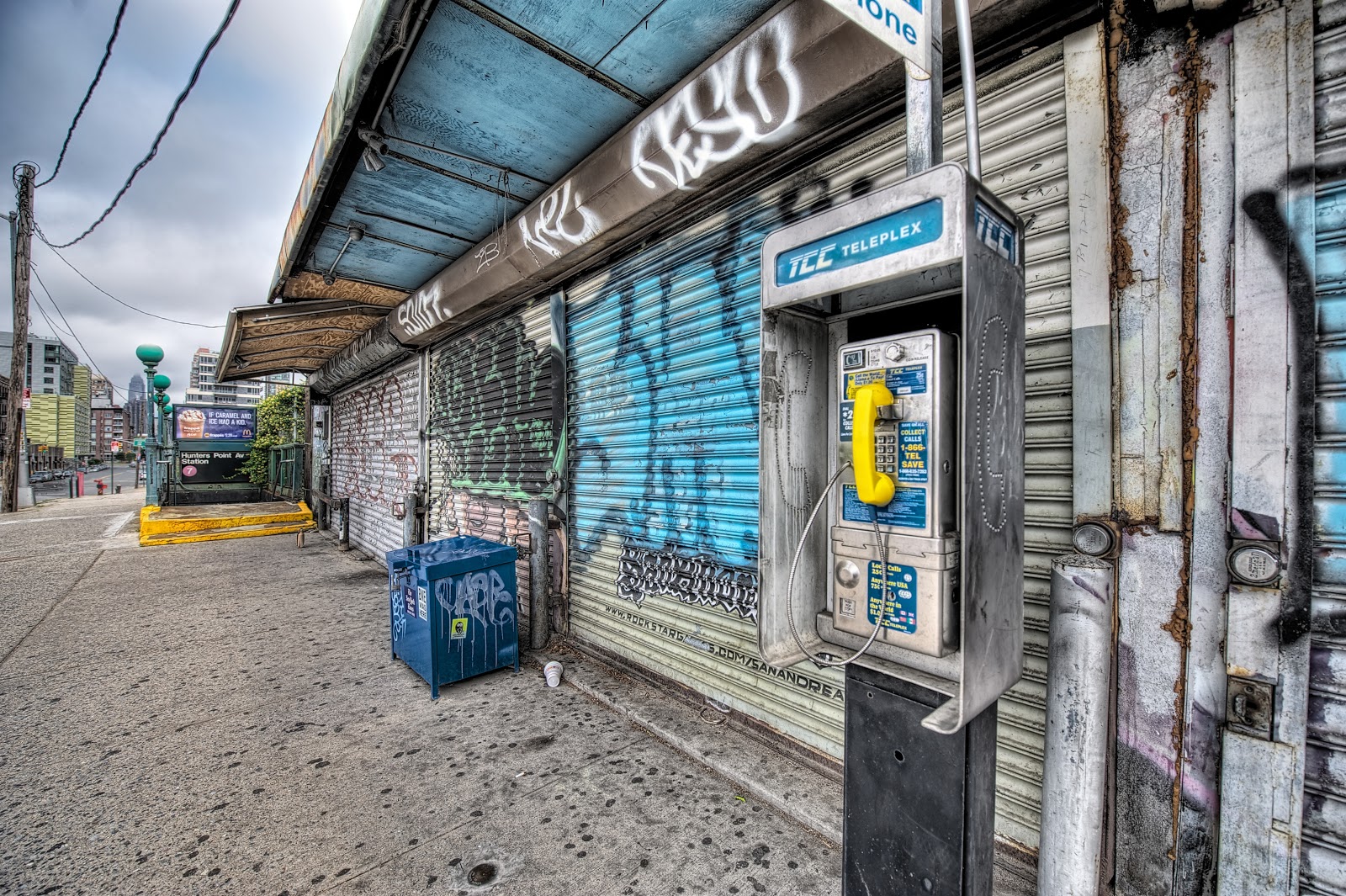
The ruin speaks out sometimes, though. For example, after Hurricane Sandy, pay phones, normally treated as part of the city’s ruined landscape, emerged suddenly to become communications life-savers; relics with an afterlife. As Ben Cohen noted, “Natural disasters tend to vindicate the pay phone” which is “mounted high and sometimes behind glass stalls [and so] generally remain serviceable during power outages, even amid flooding.” Focusing on the only problem would-be users now face, coin-overload, however, this journalist misses the real importance of so-called pay phones. They are, as indeed they were once called, public phones, situated on the streets and available to everyone. 
Though not publicly owned (they are now serviced by 13 different local pay phone franchises) they are regulated by New York’s Dept of Information Technology and Telecommunications. Said one new user of the old technology “it’s funny what’s hiding in plain sight…it’s invisible, but when you need it, it’s there.” Surely, that quaint trait of the public telephone stands synechdochally for the quaintness, in our neo-liberal context, of publicness itself. That is, it is not just the technology of the phones that is like a relic from a past time. What is funny, invisible, but hiding in plain sight is the idea of public goods, goods that conjoin people, and are to be shared among various users from all kinds of backgrounds, classes, and social locations. 
At the moment, in the aftermath of Sandy, there is talk about demanding better cell phone towers to secure coverage in emergencies, but this response is rather like the decision to build more roads for cars a century ago, in place of public transportation. There should really be more talk of securing more pay phones and more appreciation of the fact that the ones they have in NYC, that most palimpsest-like of all cities, in fact seem to work. 
The longing for public things may in fact have found expression in this week's return to discussions of climate change. It could just be one more round of emergency politics. But it could be also, or somehow, a subtle promise of collective goods, demanding our attention, offering a site of constellation to those hungry for public things.